
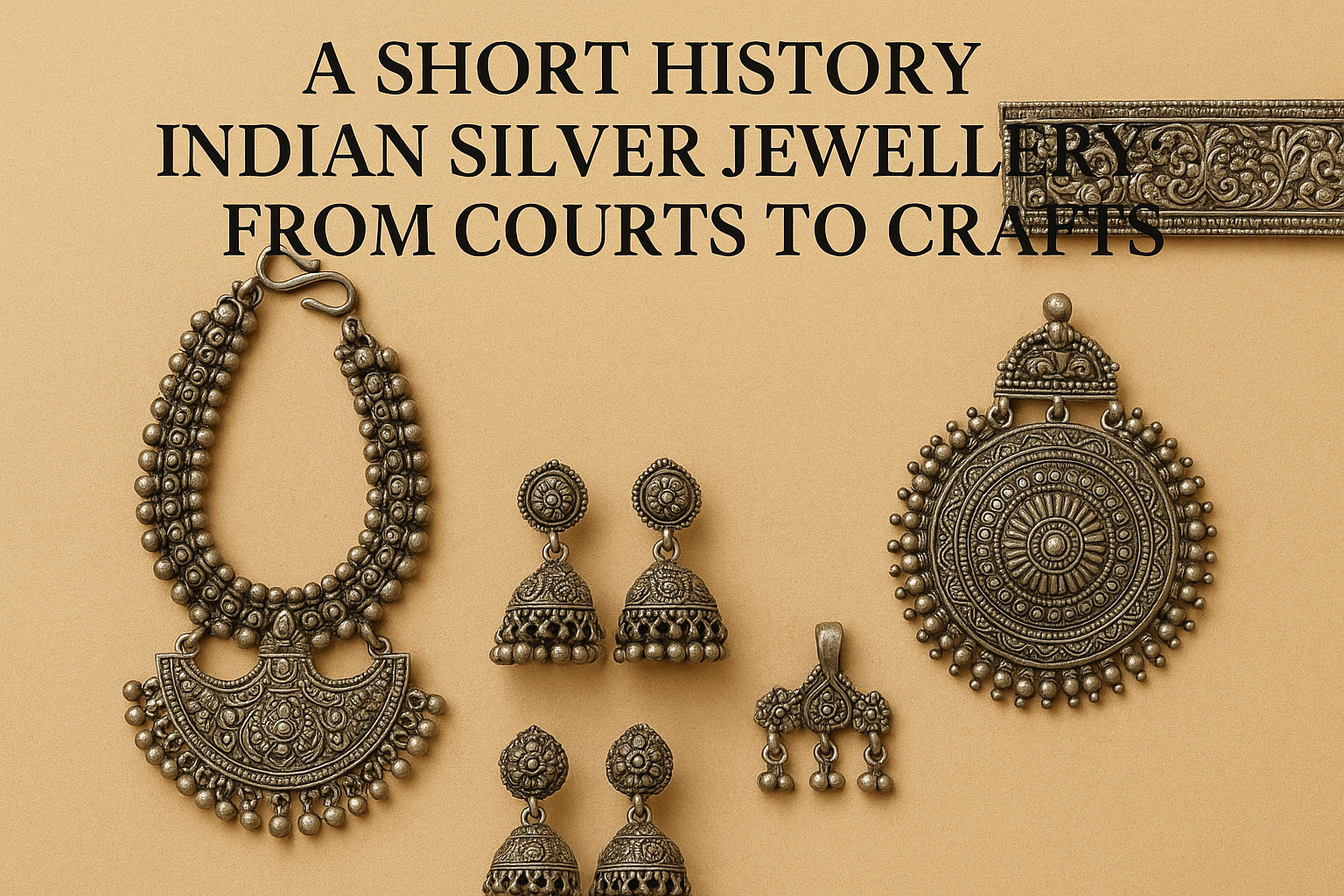
Silver has threaded through India’s story for more than four millennia—circulating as coin, ornament, temple offering, and dowry; adorning queens in marble courts and shepherds on dusty migration routes. Unlike gold, which often stayed locked in treasuries, silver kept moving. That movement—across empires, caravan routes, bazaars, and village fairs—shaped a jewellery tradition that is dazzlingly diverse and deeply lived-in.
Origins: Indus to Early Empires
Archaeology from the Indus–Sarasvati (Harappan) sites shows early metalworking skill, including beads, bangles, and small ornaments in precious metals. Silver’s pliability and soft sheen made it ideal for personal adornment even then. As the Mahajanapadas consolidated power (c. 6th–4th century BCE), punched-mark silver coins circulated widely, knitting together markets and craft centers. Early historic kingdoms—the Mauryas, Satavahanas, and Kushanas—patronized metalwork; silver bangles, ear ornaments, and hairpins appear in sculpture and terracotta reliefs from this era.
Courtly Splendor: The Classical and Sultanate–Mughal Worlds
From the Gupta period onward, elite jewellery in India tilted strongly toward gold and gemstones, yet silver never vanished. Temple treasuries commissioned silver utensils and ornaments for deities; aristocrats wore silver for daily use and travel, keeping gold for ceremony.
The great profusion arrived with the Delhi Sultanate and Mughal courts. A sustained inflow of bullion—taxes, tribute, and trade surpluses—kept the subcontinent rich in silver. Mughal mints struck the famous rūpiyā (silver rupee), and court ateliers perfected techniques that also influenced silverwork:
- Repoussé and chasing for sculptural relief on anklets, armlets, and waist belts.
- Jaali (pierced) work and kundan-style settings adapted in silver for colored glass or semiprecious stones.
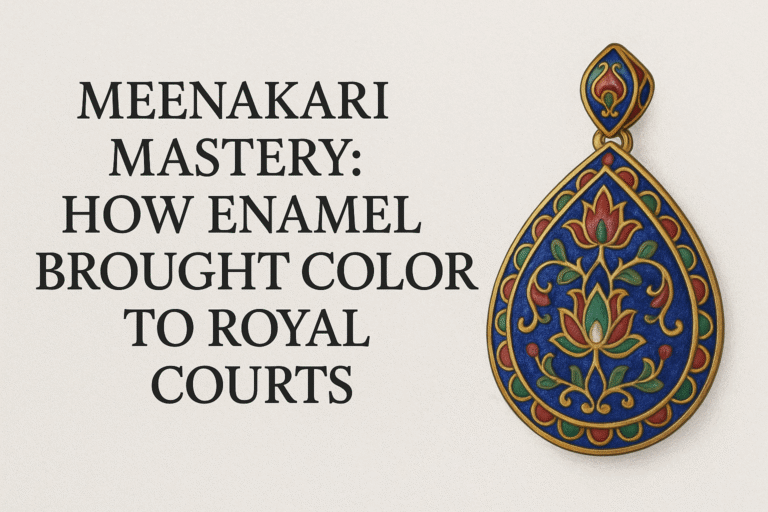
- Enamelling (meenakari) on silver in court towns like Jaipur and Lucknow, yielding playful color on otherwise cool metal.
Meanwhile, regional courts—Rajput, Maratha, Deccan sultanates—cultivated their own idioms: bold anklets in Rajasthan; elegant, ribbon-like bangles in the Deccan; gem-studded hair ornaments in Awadh. Courtly taste traveled outward through gift exchange and the movement of craftsmen, cross-pollinating urban and rural styles.
The People’s Metal: Village and Nomadic Traditions
If gold announced rank, silver mapped community. Across the subcontinent, pastoralists, cultivators, fisherfolk, and artisans fashioned identities with silver jewellery that signaled age, marital status, and clan.
- Western India (Rajasthan–Gujarat–Kutch): Massive paayal (anklets), kada (cuffs), and the famous pachchikam style in Kutch—silver settings with large table-cut glass or quartz and floral bezels. Rabari and Bharvad communities favored robust, protective forms; desert traders wore amulet pendants (taawiz) combining faith and fashion.
- Eastern India (Odisha): The filigree of Cuttack—locally called tarakasi or tarakashi—draws ultrafine silver wire into lace-like scrolls and granules. Delicate yet durable, it produced crowns for deities, nose pins, hair ornaments, and bridal sets.
- Central India (Madhya Pradesh–Chhattisgarh): Gond and Baiga jewellery leaned toward solid forms—heavy bichhua (toe rings), bell anklets, and pendants with stylized animal motifs—often combined with brass and iron for contrast.
- Himalaya (Himachal–Uttarakhand–Ladakh): High-altitude aesthetics favored large plaques and amulets. In Kullu and Kinnaur, repoussé plaques and chains layered over woolen dress; in Ladakh and Zanskar, silver framed turquoise and coral in alluring geometry.
- South India (Tamil Nadu–Karnataka–Andhra–Kerala): Silver served temple ritual and domestic life—kolusu (anklets), vanki (armlets), waist belts for children, and ritual spoons. Chettinad silversmiths refined granulation and beadwork; Kerala produced ornate silver waist girdles for classical dance and marriage rites.
Throughout, silver remained both ornament and insurance: wearable savings that could be pledged or sold in a pinch.
Colonial Shifts: Trade, Taste, and Tourism
Under the East India Company and the Raj, silver’s profile changed in three ways:
- Currency & Commodity: The silver rupee became the backbone of colonial finance until global price shocks in the late 19th–early 20th century eroded its dominance. Nonetheless, coinage circulated widely, and old rupees were frequently melted down for jewellery.
- Export Ware: Indian silversmiths catered to European demand—tea services, claret jugs, and “swami” silver (relief scenes of deities) in the south; Kashmiri and Calcutta workshops made repoussé animals, climber vines, and hunting scenes. This created new hybrid aesthetics and sustained craft livelihoods.
- Techniques in Conversation: Deccan Bidri—a blackened zinc alloy inlaid with silver—flourished as courtly taste met global markets. Filigree towns refined tools; mould-casting and die-stamping spread, enabling higher volumes for middle-class buyers.
Independence to Present: Revival, Reinvention, Regulation
Post-1947, changing wedding customs, urban migration, and new media reshaped jewellery. Gold’s prestige remained, but silver benefitted from affordability and fashion cycles:
- Studio & Designer Movements: From the late 20th century, designers collaborated with Kutch, Odisha, and Rajasthan artisans to reinterpret traditional forms—lighter pachchikam, contemporary filigree, oxidized finishes, and gemstone cabochons set in sterling.
- Everyday Modern: Silver’s hypoallergenic reputation and rising gold prices pushed urban consumers toward sterling (92.5) earrings, nose pins, and minimalist chains. Oxidized textures and matte finishes gave silver a quietly modern voice.
- Hallmarking & Standards: Bureau of Indian Standards (BIS) hallmarking expanded to silver, improving consumer confidence. While coverage is still growing, it’s increasingly common to see purity marks (e.g., 925) and maker’s stamps on quality pieces.
- Craft Economies & Sustainability: NGOs, craft clusters, and fair-trade enterprises have improved market access and design training. Recycled silver and ethical sourcing now enter design conversations; repair and upcycling extend the life of heirloom jewellery.
Techniques to Know
- Filigree (Tarakasi/Tarakashi): Twisted wires and granules soldered into lace. Odisha, Andhra, parts of Rajasthan and Telangana.
- Repoussé & Chasing: Hammered relief from reverse and refined on the front; common across court and village work.
- Granulation: Pinhead-sized beads fused to surfaces—a Chettinad and western Indian specialty.
- Openwork/Jaali: Pierced patterns for lightness and drama.
- Stone Setting: From traditional foil-backed glass to semiprecious gems; pachchikam uses silver-rich bezels with large, flat stones.
- Oxidation: Controlled blackening to highlight relief; iconic in Kutch and urban studio styles.
- Inlay & Overlay: Silver inlaid in non-silver bases (Bidri) or overlaid wires forming geometric or floral tracery.
From Courts to Crafts: What Endures
Three through-lines connect palaces and pastoral hamlets:
- Meaning Over Metal: Whether imperial anklet or village amulet, pieces are encoded with protection, fertility, status, and memory. Jewellery is biography in metal.
- Adaptable Aesthetics: Forms and motifs migrate—lotus, mango, peacock, serpent—reinterpreted for each region, faith, and fashion moment.
- Circular Value: Silver’s ready liquidity keeps it close to ordinary life. It is worn, repaired, passed on, melted, reborn—an everyday preciousness.
Collecting and Caring: Practical Notes
- Look for Marks: Prefer 925 (sterling) with a maker’s or retailer’s stamp; for older pieces, expect wear and hand-made asymmetry rather than perfect symmetry.
- Respect Patina: Oxidation and soft scratches tell a piece’s story. Clean gently with mild soap and a soft brush; avoid harsh dips on oxidized or stone-set items.
- Ask About Provenance: Artisans often belong to identifiable communities or clusters—Cuttack filigree, Kutch pachchikam, Himachali plaques. Supporting named makers sustains skills.
- Fit & Function: Traditional anklets and cuffs can be heavy; modern versions offer hollow or hinged designs to balance comfort and look.
- Repair First, Replace Later: Many village-style pieces are modular; a good silversmith can re-solder links, replace hooks, or re-set stones.
The Present Future
Today’s Indian silver jewellery is happily plural: heirloom tribal anklets worn with sneakers; filigree hoops at a board meeting; a Bidri inlay cuff beside a smartwatch. Designers mine museum archives while artisans bring centuries of muscle memory to fresh collaborations. The “court” survives in technique and finish; the “craft” thrives in daily wear and cultural continuity.
Silver, the people’s precious metal, keeps doing what it always has in India—circulating stories.

You would want to ensure the plugin is installed and activated for the section to be visible.